




Dr. Jennifer Commins (Post Doc)

Contact Details:
Email: jennifer.commins@tcd.iePhone: +353 (0) 1 8962873
Atomic density sheds light on the evolutionary characteristics of proteins
Identifying adaptive evolution is instrumental to the understanding of diversity on earth, protein engineering, and drug design. The study of evolution is based on many assumptions that are too often taken as "gospel". In particular, the study of and search for adaptive evolution or more commonly - positive selection within and between species has been abundantly reported in the literature for the last 20 years. Methods have been developed and verified using the mathematics of populations genetics, simulated populations of sequences, and real sequences and then reported to be for the most part correct. In the majority of cases software's developed in this field of expertise focused on detecting positive selection at single amino acid sites claiming this as a breakthrough achievement. Protein sequences do not perform functions unless folded into their native conformation.
Selection acts at the three-dimensional level to such an extent that functionally advantageous but structurally destabilizing mutations are never fixed unless they escape this adaptive conflict through duplication. Given this fact, we are adamant that instead of looking at sequences as linear data-sets and identifying selective constraints at single sites that we should take into account the weighted pressure of selection exercised over sites based on their structural location.
We have developed a method of calculating the atom density of each amino acid within a three-dimensional structure and using that information to segregate out the DNA and amino acid sites into density-range specific categories. In doing this we believe that more accurate results may be retrieved from software methods designed to detect positive selection. In addition, in analysing data divided into these "sub-alignments" based of atom density we have discovered several interesting characteristics of the data that vary depending on the atom density category being studied. The data set that we have used is all non-redundant proteins that were deposited in the Protein Data Bank on or before March 2008. A set of unique homologue sequences was collected for ever protein structure in our analysis using tblastn. Subsequently each set of sequences was aligned and analysed using our atom density calculator. Each data set and sub-data set was also analysed to calculate divergence levels and the non-synonymous-to-synonymous rates ratio (dN/dS) values.
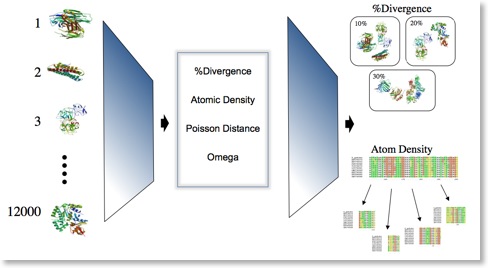
When the data was plotted and scrutinized with respect to the characteristics investigated, it became clear that more information is retrievable when sequences of interest are sub-divided into atom density categories. Divergences levels and dN/dS values both show significant differences when categorised by atom density. This is an important breakthrough and is a natural foundation for future work using data sets that are more specific and more information from the protein structures themselves in order to accurately indicate sites or regions of proteins that are of interest with respect to adaptive evolution.
Publications:
Book Chapter:
McInerney, J.O., Finnerty, C., Commins, J., and Philip, G.K. Chapter: Gene evolution and drug discovery. Bioinformatics and Drug Discovery. Humana Press (2006).Papers:
Commins, J., Toft, C. and Fares, M.A., Computational Biology Methods and Their Application to the Comparative Genomics of Endocellular Symbiotic Bacteria of Insects Biological Procedures. Biol Proced Online. 2009 Mar 11. [Epub ahead of print]Commins, J., Toft, C., Codoner, F., and Fares, M.A. Atomic Density Sheds Light on
the Evolutionary Characteristics of Proteins. Submitted for review
Presentations:
December 2003:Postgraduate Research Colloquium, NUI Maynooth.
Title: Maximum Likelihood Methods for the Detection of Adaptive Evolution.
March 2005:
Biology Departmental Seminar, NUI Maynooth.
Title: Ramble – The Adaptive Evolution Simulator.
March 2005:
Postgraduate Research Colloquium, NUI Maynooth.
Title: Ramble – The Adaptive Evolution Simulator.
June 2005:
Evolution 2005: Fairbanks, Alaska, USA.
Title: Assessing the accuracy of methods for detecting adaptive evolution.
June 2008
Smurfit Institute Seminar Series, Trinity College Dublin
Title: The McDonald Kreitman Test and Slightly Deleterious Mutations
December 2008
Rocky 08: Snowmass Village, Colorado, USA.
Title: Atomic Density Sheds Light on the Evolutionary Characteristics of Proteins
Poster Presentations:
June 2003:ISMB 2003, Brisbane, Australia.
Title: Novel Maximum Likelihood Methods for Detecting Adaptive Evolution.
March 2004:
RECOMB 2004, San Diego, USA.
Title: Novel Maximum Likelihood Methods for Detecting Adaptive Evolution.
July 2004:
ISMB/ECCB 2004, Glasgow, Scotland.
Title: RAMBLE: The Adaptive Evolution Simulator.
June 2005:
Evolution 2005, Fairbanks, Alaska,
Title: RAMBLE: The Adaptive Evolution Simulator.
September 2005:
RECOMB Comparative Genomics Satellite Meeting, Trinity College, Dublin.
Title: RAMBLE: The Adaptive Evolution Simulator.
